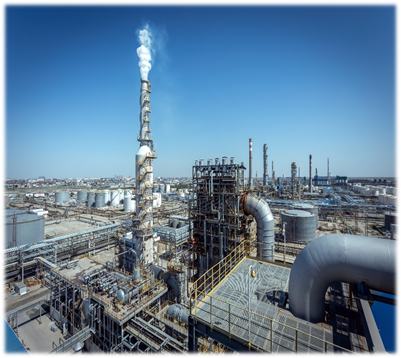
We recognize the significant impact of our activities on the atmosphere and the environment. Therefore, we are focused on developing a strategy to reduce and control air emissions and exploring the possibility of implementing innovative technologies and projects. We strive to comply with national and international environmental regulations regarding air emissions.
At Altai Oil Refinery, the following priority areas have been identified in relation to atmospheric air:
In 2019, Altai Oil Refinery LLP revised the draft standards for maximum permissible emissions of pollutants (MPE) for 2019-2028, and received a positive conclusion from the Department of Ecology of the Atyrau Region. Based on the positive conclusion of the Ministry of Ecology, Geology and Natural Resources of the Republic of Kazakhstan, the plant was issued a permit for environmental emissions (EP) for 2019-2020.
The main principle of Altai Oil Refinery LLC is strict compliance with emission standards and limits for pollutant emissions specified in the permit for emissions into the environment.
In recent years, the refinery has undergone a number of modernizations and reconstructions. For example, from 2011 to 2018, the refinery implemented the Deep Oil Refining Complex (DORC) project, which is included in the list of strategic investment projects of the Republic of Kazakhstan and implemented in accordance with the state program for industrial and innovative development, the Industrialization Map for 2015-2019, and the Strategic Plan of the Ministry of Energy of the Republic of Kazakhstan.
Since January 1, 2018, the production and sale of gasoline and diesel fuel below class K4 and K5, which are identical to EURO-4 and EURO-5 standards, has been prohibited by law in Kazakhstan.
By reducing the amount of sulfur and benzene in gasoline and diesel fuel, the toxicity of exhaust emissions is reduced. For example, K4 gasoline contains 50 mg/kg of sulfur, while K5 contains 10 mg/kg. This is 10-50 times less than the outdated K2 grade.
As part of the construction of the Catalytic Cracking Unit (CCU), a catalytic cracking unit was built. It utilizes internationally licensed BELCO technology, based on a wet gas cleaning system (wet scrubber). The system is designed to remove sulfur oxide, nitrogen oxides, and fine catalyst dust from the CCU's exhaust gases.
A comprehensive amine fuel gas purification technology, using absorption in a diethanolamine solution, was also implemented. The amine unit is designed to remove acidic components such as hydrogen sulfide, carbon dioxide, and carbon monoxide from the fuel gas, eliminating toxic combustion emissions from the plant's process furnaces and thereby minimizing the harmful environmental impact.
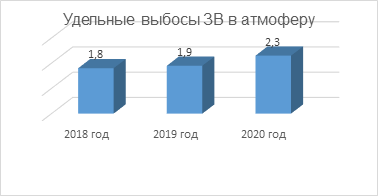
Specific emissions of pollutants into the atmosphere, tons/1000 tons, from refined oil
| 2018 | 2019 | 2020 |
|---|---|---|
| 1,8 | 1,9 | 2,3 |